Email is like your digital home address. You give it out, and suddenly people know where to reach you—sometimes a little too easily. In today’s internet-driven world, choosing between a temporary email and a permanent email isn’t just a technical decision; it’s a privacy decision.
So which one should you use? Let’s break it down in a clear, no-nonsense way.
Why Email Choice Matters Today
Every signup, download, or subscription asks for an email. Choose wrong, and you’re signing up for spam, tracking, and long-term data exposure.
Temporary vs Permanent Email at a Glance
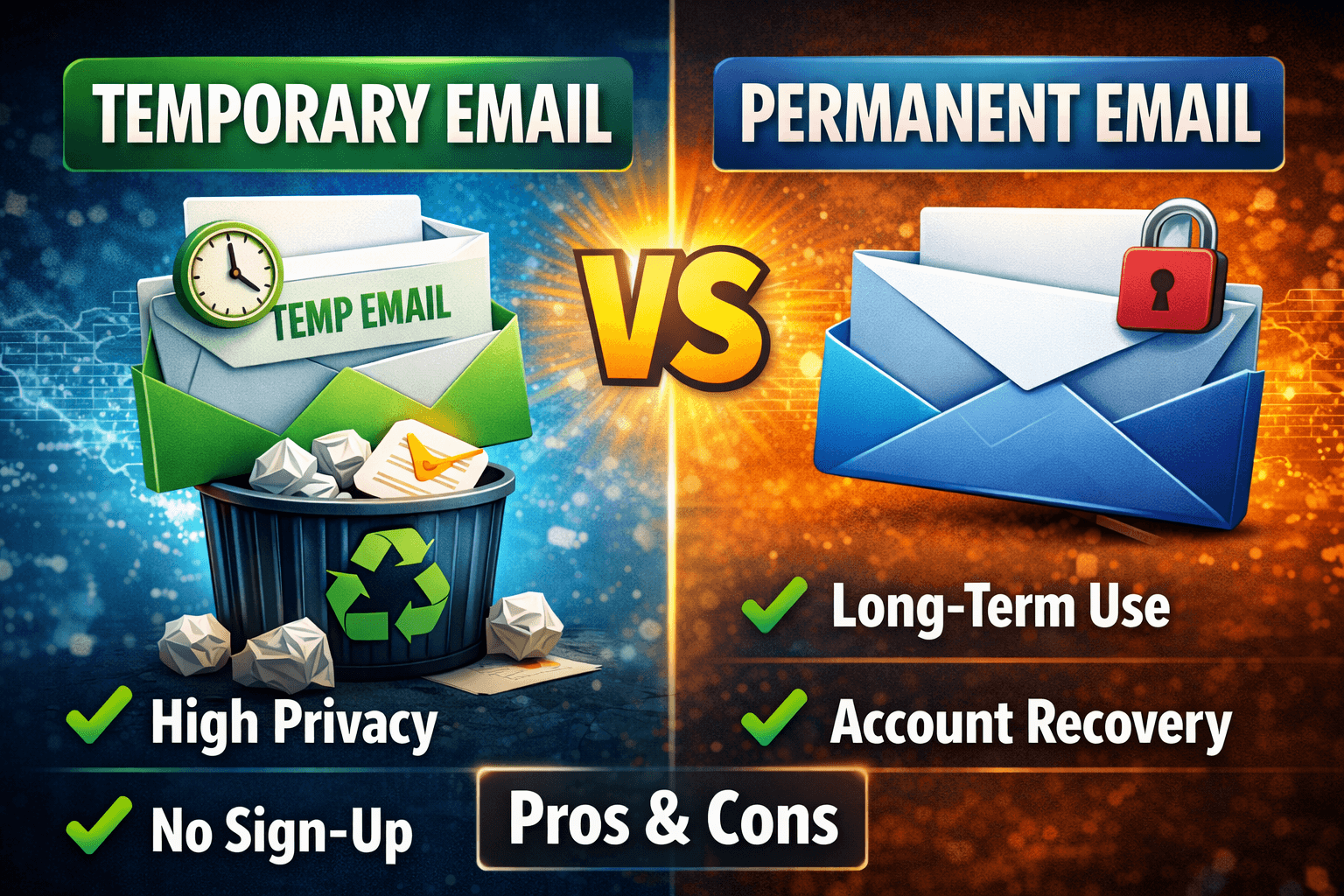
One is short-lived and anonymous. The other is long-term and identity-based. Both have their place.
What Is a Temporary Email?
Definition and Purpose
A temporary email (also called disposable email) is an email address designed for short-term use. It doesn’t require registration, passwords, or personal details.
Think of it like a sticky note—you use it, read it, then throw it away.
How Temporary Emails Work
-
Email address is generated instantly
-
Receives messages in real time
-
Expires automatically
-
Inbox is deleted forever
Simple, fast, and anonymous.
What Is a Permanent Email?
Definition and Examples
A permanent email is your traditional email account—like Gmail, Outlook, or Yahoo—that you use for long-term communication.
It’s tied to your identity and stays active as long as you maintain it.
How Permanent Email Accounts Work
-
Requires registration and password
-
Stores emails indefinitely
-
Supports account recovery
-
Linked to multiple services
Key Differences Between Temporary and Permanent Email
Privacy
Temporary emails offer high privacy since they aren’t linked to you. Permanent emails are often tracked, stored, and analyzed.
Security
Permanent emails offer better recovery options. Temporary emails trade recovery for anonymity.
Usability
Permanent emails are accepted everywhere. Temporary emails may be blocked on some platforms.
Longevity
Temporary emails expire. Permanent emails stay for years.
Pros of Temporary Email
Strong Privacy Protection
Your real email stays hidden. That’s a big win in a data-hungry world.
No Registration Required
No forms. No passwords. Instant access.
Spam Prevention
Spam goes to the disposable inbox—not your main one.
Ideal for One-Time Use
Perfect for:
-
Free trials
-
Downloads
-
Forums
-
Testing tools
Cons of Temporary Email
No Account Recovery
Once it expires, it’s gone forever.
Limited Acceptance by Websites
Some platforms block disposable emails.
Not Suitable for Important Accounts
Never use it for banking or critical services.
Pros of Permanent Email
Long-Term Reliability
Your email stays with you across years and devices.
Account Recovery Options
Forgot your password? No problem.
Professional Communication
Essential for business and work.
Trusted by All Platforms
Every service accepts permanent emails.
Cons of Permanent Email
Spam Overload
Once leaked, spam never stops.
Privacy Risks
Your email becomes a tracking ID.
Data Breach Exposure
If one site is hacked, your email may be exposed everywhere.
Use Cases for Temporary Email
Free Trials
Test services without future marketing emails.
App and Website Testing
Developers love disposable emails.
Online Downloads
Access resources without long-term commitments.
Use Cases for Permanent Email
Banking and Finance
Always use permanent, secure emails.
Work and Business
Professional identity matters.
Long-Term Subscriptions
Services you plan to use for years.
Temporary Email and Online Privacy
Digital Footprint Reduction
Less data shared means less tracking.
Avoiding Tracking
Disposable emails break the tracking chain.
Permanent Email and Identity Management
Email as a Digital Identity
Your email often defines your online identity.
Risks of Overexposure
Using one email everywhere increases risk.
Which One Should You Use?
Choosing Based on Purpose
Use temporary emails for short-term needs. Permanent emails for long-term relationships.
Using Both Strategically
Smart users use both, depending on the situation.
Future of Email Usage
Privacy-Focused Trends
Privacy-first tools are on the rise.
Rise of Disposable Email Services
As spam and breaches increase, disposable email usage will grow.
Conclusion
Temporary and permanent emails aren’t competitors—they’re tools. Used correctly, they give you flexibility, privacy, and control.
The smartest approach? Use permanent email for what matters and temporary email for everything else.
FAQs
1. Is temporary email safe to use?
Yes, for non-sensitive and short-term use.
2. Can I use temporary email for verification codes?
Yes, most verification emails work fine.
3. Why do some websites block temporary emails?
To prevent abuse and fake accounts.
4. Should I have more than one permanent email?
Yes, separating work and personal emails is a good idea.
5. Can I use both temporary and permanent emails together?
Absolutely—and that’s the smartest strategy.